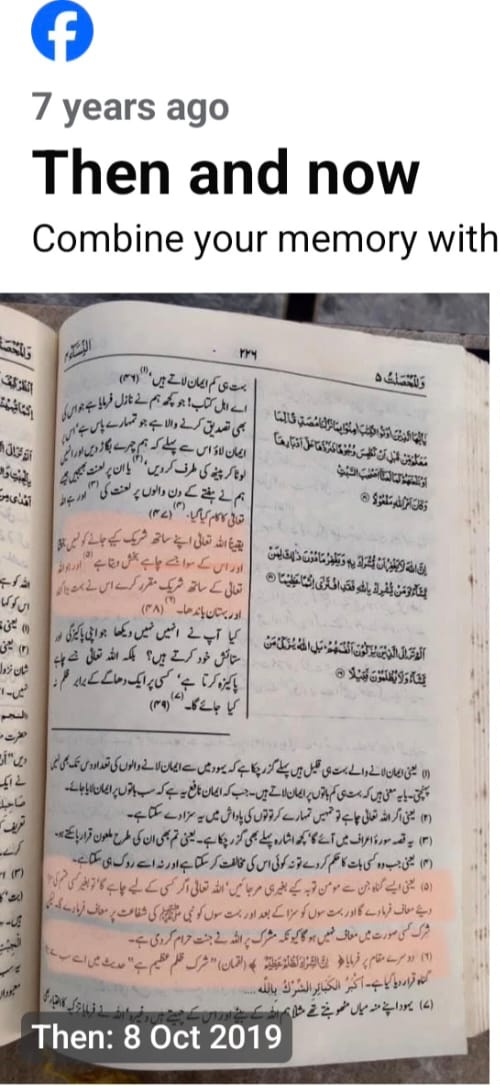
Seven Years Ago, a Verse. Today, a Question.
Exactly seven years ago, as I was undergoing a change in my thinking and spiritual outlook, I was reading the Qur’an alongside its translation and commentary. During that reading, a verse from Surah An-Nisa stopped me in my tracks. I marked it because it raised a question I could not easily set aside.
إِنَّ اللَّهَ لَا يَغْفِرُ أَنْ يُشْرَكَ بِهِ وَيَغْفِرُ مَا دُونَ ذَٰلِكَ لِمَنْ يَشَاءُ“Indeed, Allah does not forgive association with Him, but He forgives what is less than that for whom He wills.”Qur’an 4:48 ↗ · Translation of the cited portion
A question began forming in my mind then, and I returned to it from time to time. Today, exactly seven years later, that same marked verse has appeared before me again. But the question now feels much deeper.
If Satan is an open enemy of humanity, intent on turning people away from Allah’s straight path, could one of his most dangerous deceptions be to make someone regard a mistaken belief or action not as an error, but as goodness, guidance, or nearness to Allah?
And if such a mistake were to involve shirk—associating partners with Allah—while the person continued to see it as a good deed, how would they even recognize the need to repent?
Who Is Humanity’s Enemy?
إِنَّ الشَّيْطَانَ لَكُمْ عَدُوٌّ فَاتَّخِذُوهُ عَدُوًّا“Indeed, Satan is an enemy to you; so take him as an enemy.”Qur’an 35:6 ↗
When Iblis refused the command to prostrate before Adam (peace be upon him), he responded arrogantly: “I am better than him. You created me from fire and created him from clay.” Qur’an 7:12 ↗
He then requested respite and declared his intention to mislead the descendants of Adam:
“I will surely sit in wait for them on Your straight path. Then I will come to them from before them and from behind them and on their right and on their left.”Qur’an 7:16–17 ↗ · Rendering of the cited passages
Something in this declaration makes me think carefully. Iblis did not name just one sin or one form of wrongdoing. He spoke of “Your straight path.”
If the enemy declares that he will lie in wait even on the straight path, is being religious, by itself, a guarantee that a person is safe from every deception?
Misguidance Does Not Always Take the Same Form
There are many ways in which a person can be drawn away from Allah: unchecked desires, sexual immorality, injustice, addiction, arrogance, obsession with wealth, wrongdoing, disregard for religion, and doubts about Allah can all become tests.
“I will surely mislead them, and I will surely arouse in them [sinful] desires.”Qur’an 4:119 ↗ · Excerpt
Yet another possibility is more subtle. A person may not be distant from religion. They may be observant, worship regularly, seek nearness to Allah, and sincerely regard their actions as good. But what if a fundamental error has entered their understanding at precisely that point?
When a Wrong Action Begins to Look Right
أَفَمَنْ زُيِّنَ لَهُ سُوءُ عَمَلِهِ فَرَآهُ حَسَنًا“Then is one to whom the evil of his deed has been made attractive so he considers it good…?”Qur’an 35:8 ↗ · Opening phrase
Elsewhere, the Qur’an describes how Satan made people’s deeds appear attractive to them. Qur’an 6:43 ↗
It also describes people who وَيَحْسَبُونَ أَنَّهُمْ مُهْتَدُونَ “think that they are guided.” Qur’an 7:30 ↗ · Excerpt
Why Is Shirk Such a Serious Matter?
Let us return to the verse I marked seven years ago: Allah does not forgive associating partners with Him, but may forgive lesser sins for whom He wills. Qur’an 4:48 ↗
An essential clarification is needed here. This verse does not mean that someone who sincerely repents of shirk during their lifetime is beyond Allah’s forgiveness.
“Do not despair of the mercy of Allah. Indeed, Allah forgives all sins.”Qur’an 39:53 ↗ · Excerpt
The door to sincere repentance and turning back to Allah remains open during life. The severe warning in Surah An-Nisa is understood to concern someone who dies upon major shirk without repenting of it.
If someone sees a mistaken belief or practice as goodness, guidance, and nearness to Allah, what would prompt them to repent of it?
Is Good Intention Enough?
“We only worship them that they may bring us nearer to Allah in position.”Qur’an 39:3 ↗ · Excerpt of the argument reported in the verse
This highlights an important principle: the desire to draw nearer to Allah matters, but good intentions alone do not automatically make every belief or act of worship correct.
In Islamic belief, worship belongs to Allah alone. Nor is the issue of shirk exhausted by the image of bowing before a stone idol. That is why we must examine beliefs and acts of worship against the standards established by Allah and His Messenger ﷺ.
Can Someone Think They Are Doing Good and Still Be Wrong?
“Those whose effort is lost in worldly life, while they think that they are doing well in work.”Qur’an 18:104 ↗ · Excerpt
This verse has a specific context: the following verse speaks of denying Allah’s signs and the meeting with Him. Applying it directly to every Muslim with whom one disagrees, or to every disputed religious practice, would be an abuse of its context.
The fact that I believe myself to be right is not, in itself, proof that I am right.
Love for the Prophet ﷺ, Intercession, and Tawhid
Love for the Messenger of Allah ﷺ is part of faith, and Muslims hope for his intercession. Yet intercession remains subject to Allah’s authority and permission.
Abu Hurayrah (may Allah be pleased with him) narrated that the Prophet ﷺ spoke of reserving his supplication for the intercession of his community on the Day of Resurrection. He explained that, Allah willing, it would reach the one among his community who dies:
مَنْ مَاتَ مِنْ أُمَّتِي لَا يُشْرِكُ بِاللَّهِ شَيْئًا“…without associating anything with Allah.”Sahih Muslim 199a · Book of Faith ↗ · Excerpt
Love, devotion, and spiritual attachment have their place. But in questions of salvation, our standard must be the one established by Allah and His Messenger ﷺ.
What Will Satan Say in the End?
“I invited you, and you responded to me. So do not blame me; but blame yourselves.”Qur’an 14:22 ↗ · Excerpt
Satan can whisper, try to mislead, and make wrongdoing seem attractive. But ultimately, human beings remain responsible for their choices. The purpose of this research is therefore not to magnify Satan’s power or generate fear. It is to awaken a more careful examination of our beliefs, actions, and direction.
This Research Is Not About Judging Others. It Begins With Me.
This article is not a verdict against any sect, community, individual, or spiritual order. Nor is it an invitation to begin scrutinizing other people’s beliefs as soon as we finish reading.
The first person this research addresses is me.
Each of us has inherited many religious ideas from family, environment, teachers, and society. Much of what we have learned may be sound. But have we ever made a serious effort to examine the foundations of what we understand to be religion?
The error may not lie in someone else’s understanding. It may lie in my own. That is why this research offers an invitation rather than a ready-made judgment: take another careful look at your beliefs and actions.
If our understanding is sound, research can strengthen it. And if an inherited assumption or interpretation proves mistaken, discovering that is not a defeat. It is an opportunity to correct ourselves.
Could I Be the One?
Seven years ago, I marked a verse of the Qur’an. Today, it confronts me with a larger question. The Qur’an calls Satan humanity’s enemy. It records his declaration that he will lie in wait along the straight path. It also shows that wrongdoing may appear beautiful to a person, and that someone may believe themselves guided while being mistaken.
Could I, too, be caught in a deception I have not recognized?
Perhaps you can ask yourself a similar question: Is it possible that I am failing to recognize an error because I have always understood it to be right?
Nuqta-e-Rabt — Research Methodology
Qur’an → Authenticated Sunnah → Context → Credible Scholarly Interpretation → Conclusion
No single exegete, scholar, sect, or intellectual tradition will be treated as the sole standard of research. Where credible scholarly differences exist, they will be represented fairly. We will not search for evidence merely to prove a sect right or wrong. We will examine the evidence, then ask where it leads.
What we regard as guidance—is it truly the guidance taught by Allah and His Messenger ﷺ?
May Allah enable us to recognize truth as truth and follow it, to recognize falsehood as falsehood and avoid it, to remain protected from every form of shirk, and never to neglect repentance and self-correction. Ameen.
Primary References
- Qur’an, An-Nisa: 4:48, 4:119
- Qur’an, Al-A‘raf: 7:12, 7:16–17, 7:30
- Qur’an, Al-An‘am: 6:43
- Qur’an, Ibrahim: 14:22
- Qur’an, Al-Kahf: 18:104–105
- Qur’an, Fatir: 35:6, 35:8
- Qur’an, Az-Zumar: 39:3, 39:53
- Sahih Muslim 199a, Book of Faith — Hadith on Intercession ↗